

The McGill Big 3 are three core exercises described by Dr. Stuart McGill, who led spine biomechanics research at the University of Waterloo. They are the curl-up, the side bridge and the bird dog. They are widely used for low back pain because they work the trunk muscles while the spine stays in a neutral position. This post explains how to do them and what the research shows. For the first days of a back strain, see Low Back Sprain and Strain.
The Three Exercises
Curl-up. Lie on your back with one knee bent and the other leg straight. Place your hands under the small of your back. Lift your head and shoulders slightly off the floor without flattening your back, hold, then lower.

Side bridge. Lie on your side, propped on your elbow, with your knees bent. Lift your hips so your body forms a straight line from knees to shoulders, hold, then lower. Repeat on the other side. Move to supporting on your feet when the knee version is easy.
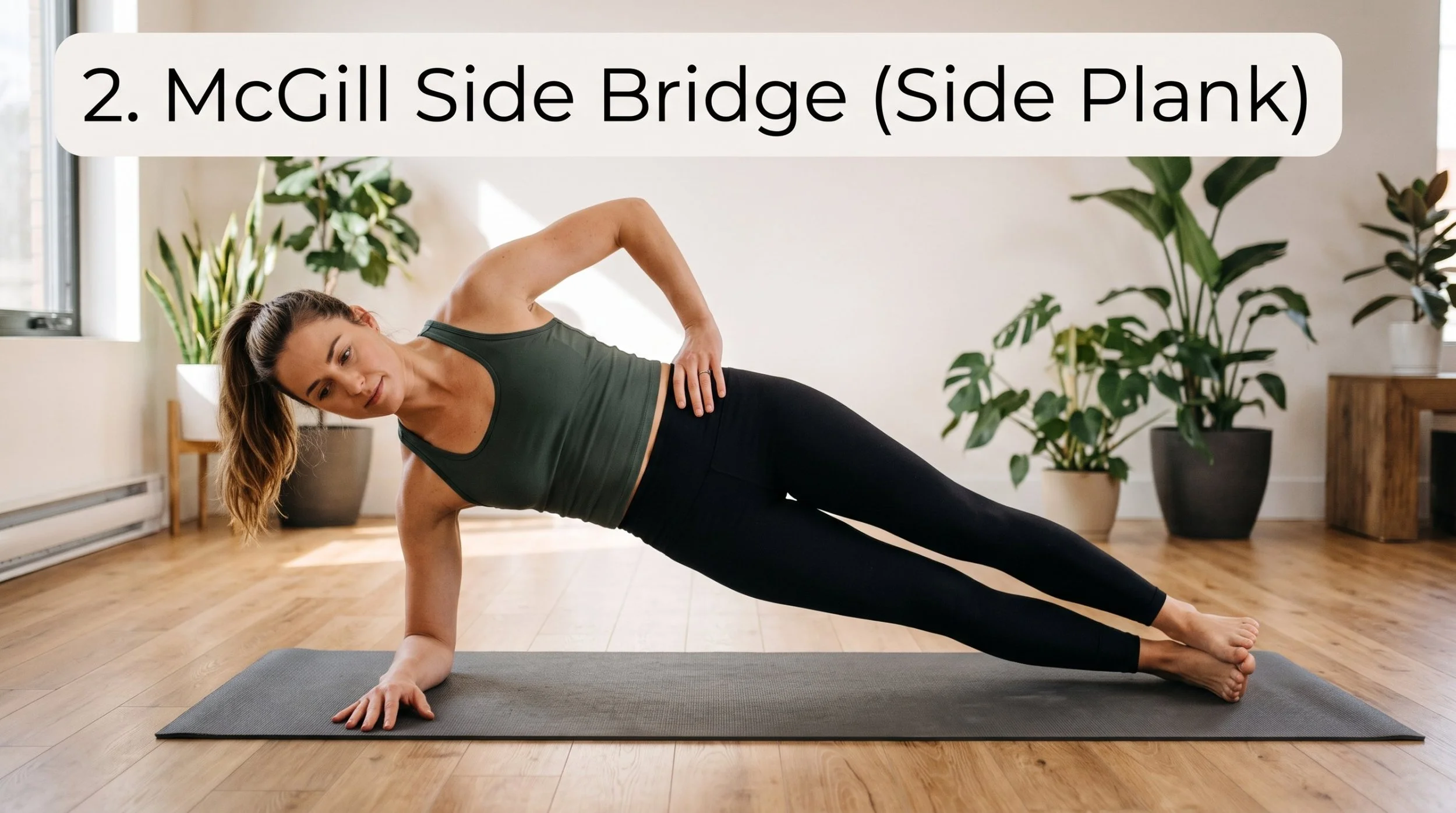
Feet-supported version shown; start from the knees if this is too hard.
Bird dog. Start on your hands and knees. Reach one arm forward and the opposite leg back until both are level with your trunk, hold, then return. Repeat on the other side. Keep your hips and low back still.

How to Start
Hold each repetition for up to about 10 seconds and breathe normally.
Build endurance by adding repetitions, not longer holds. A common pattern is descending sets, such as 5, 3 and 1 repetitions, with a short rest between sets.
Stay within a comfortable range. Muscle effort is expected. Sharp pain, or pain that spreads into the leg, is a reason to stop and have it checked.
Aim for most days of the week. The routine takes about 10 minutes.
What the Research Shows
McGill's laboratory measured muscle activity and spine position during different versions of the three exercises, and used the results to set out progressions from easier to harder.
Clinical trials of the Big 3 are small. In one trial, 34 people with chronic low back pain did either McGill exercises or conventional physiotherapy exercises for six weeks. The authors reported an additional benefit in pain and function for the McGill group.
A 2022 review, published as a preprint that has not been peer reviewed, concluded that the trials of this program are low in quality with mixed results, and that the data supporting it are limited.
The evidence for exercise in general is stronger. A Cochrane review concluded that exercise probably reduces pain in chronic low back pain compared with no treatment or usual care.
Taken together, the Big 3 are a reasonable, low-load place to start. They have not been shown to work better than other types of exercise, and the best program is one you will keep doing.
Who They Suit
The Big 3 suit many people with ongoing or recurring low back pain who want a simple routine. They are a starting point, and most people go on to add walking, strength training or their sport.
Have your back assessed before starting if your pain is severe, travels below the knee, or comes with numbness, tingling or weakness in a leg. Seek prompt medical attention for back pain with loss of bladder or bowel control, numbness around the groin, leg weakness that is getting worse, fever or unexplained weight loss, or after a significant fall or accident.
What to Expect
An assessment first, to find the positions and movements that bring on your pain.
Exercises chosen and adjusted for you. The Big 3 are one option among several.
A check of your technique, then a reassessment after a short course of care.
Not everyone improves. If you are not improving at the reassessment, the plan is changed or you are referred on.
Book an Assessment in NW Calgary
Dr. Lau will assess your back first and show you which exercises suit you. Dr. Michael Lau, Calgary Chiropractor, 3604 52 Ave NW #138, Calgary, AB T2L 1V9. Call (403) 282-4004 or book online. Related reading: Low Back Sprain and Strain and the Sciatica and Low-Back Pain page.