
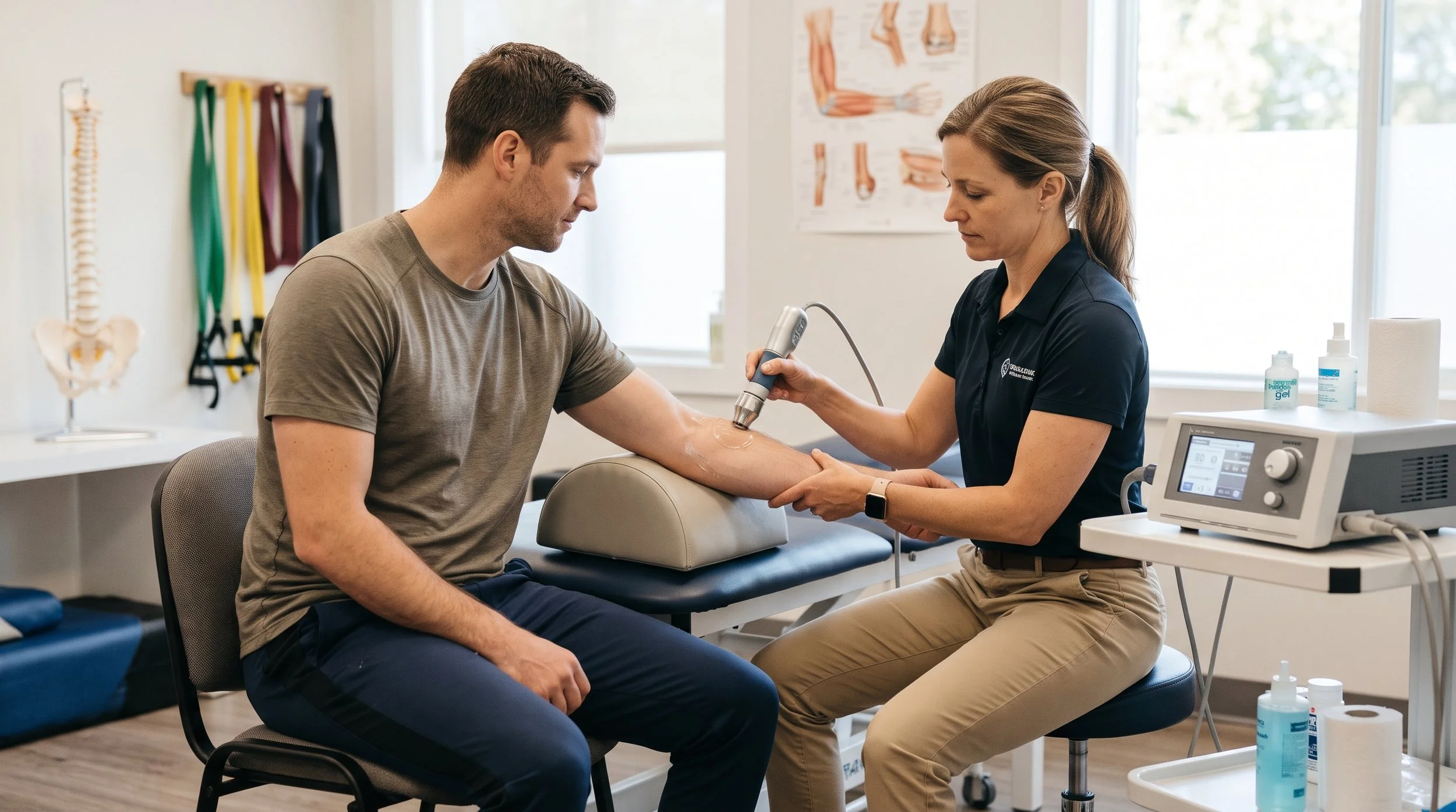
Shockwave therapy is often suggested when tendon pain has dragged on for months. The research behind it is not the same for every tendon, so this post looks at three common ones: the Achilles tendon, tennis elbow and calcific tendinopathy of the shoulder. For heel pain, see Shockwave Therapy for Plantar Fasciitis. For session details and fees, see the Shockwave Therapy page.
Where Shockwave Fits in Tendon Care
Shockwave therapy sends pressure waves through the skin into a painful tendon. Dr. Michael Lau, Calgary Chiropractor, uses radial shockwave, which spreads its energy outward from the applicator and is commonly used for tendons close to the surface. For most tendon problems the foundation of care is a progressive strengthening (loading) program and adjusting how much the tendon is asked to do. Shockwave is an add-on to that program, not a replacement for it.
Achilles Tendon Pain
A Dutch multidisciplinary guideline puts education, activity changes and at least 12 weeks of calf strengthening first. It lists shockwave as something to consider when that has not given enough relief.
In a randomized trial of 68 people with long-standing mid-portion Achilles tendon pain, those who had low-energy shockwave added to calf-lowering exercises scored better at four months than those who did the exercises alone (87 versus 73 out of 100 on a standard Achilles questionnaire). At one year the two groups no longer differed, and by then some participants had changed treatment.
What this means: shockwave is a reasonable add-on when a good loading program has not been enough. The supporting trials are small.
Tennis Elbow
Here the research disagrees. A 2020 meta-analysis that compared shockwave with other treatments concluded that it eased pain and improved grip strength. A 2021 review of 27 trials and 1,871 patients reached a more cautious conclusion: with low to moderate certainty, shockwave offered no clinically important benefit over sham treatment or cortisone injection, although it did better than laser and ultrasound.
What this means: shockwave is not a first choice for tennis elbow. Loading exercises and changes to gripping and lifting come first. If the elbow has not settled, a short trial of shockwave with a clear review point is an option to discuss.
Calcific Tendinopathy of the Shoulder
In this condition, calcium deposits form in the rotator cuff tendons. It is confirmed on X-ray or ultrasound.
A systematic review of 28 randomized trials in the Annals of Internal Medicine found that high-energy shockwave was better than placebo for pain, shoulder function and clearing of the deposits. Results for low-energy shockwave, and for shoulder tendon pain without calcium deposits, were inconclusive.
High-energy treatment is usually delivered with focused devices. For radial shockwave, one randomized trial of 90 people reported less pain and better shoulder function after treatment and at six months. That is a single trial, so the evidence for radial shockwave here is thinner.
What this means: Dr. Lau will assess your shoulder and any imaging first. If radial shockwave is not a good fit, he will explain why and talk through other options, including referral.
What to Expect If You Try It
A typical course is 5 to 10 sessions about a week apart, followed by a reassessment.
Sessions can be uncomfortable. The intensity is adjusted to keep it tolerable.
Soreness, redness or mild bruising for a day or two afterward can happen.
You keep doing your loading exercises throughout.
Shockwave does not suit everyone. Dr. Lau will ask about pregnancy, bleeding disorders, blood-thinning medication and other health factors before starting.
Not everyone improves. If you are not improving at the reassessment, the plan changes.
The Short Version
Achilles tendon: a reasonable add-on when loading exercises alone have not been enough.
Tennis elbow: mixed evidence, so exercise comes first.
Calcific shoulder: the best evidence is for high-energy shockwave; radial shockwave has less research behind it.
Book an Assessment in NW Calgary
Dr. Lau will assess your tendon pain first and let you know whether shockwave is a reasonable option. Dr. Michael Lau, Calgary Chiropractor, 3604 52 Ave NW #138, Calgary, AB T2L 1V9. Call (403) 282-4004 or book online.