
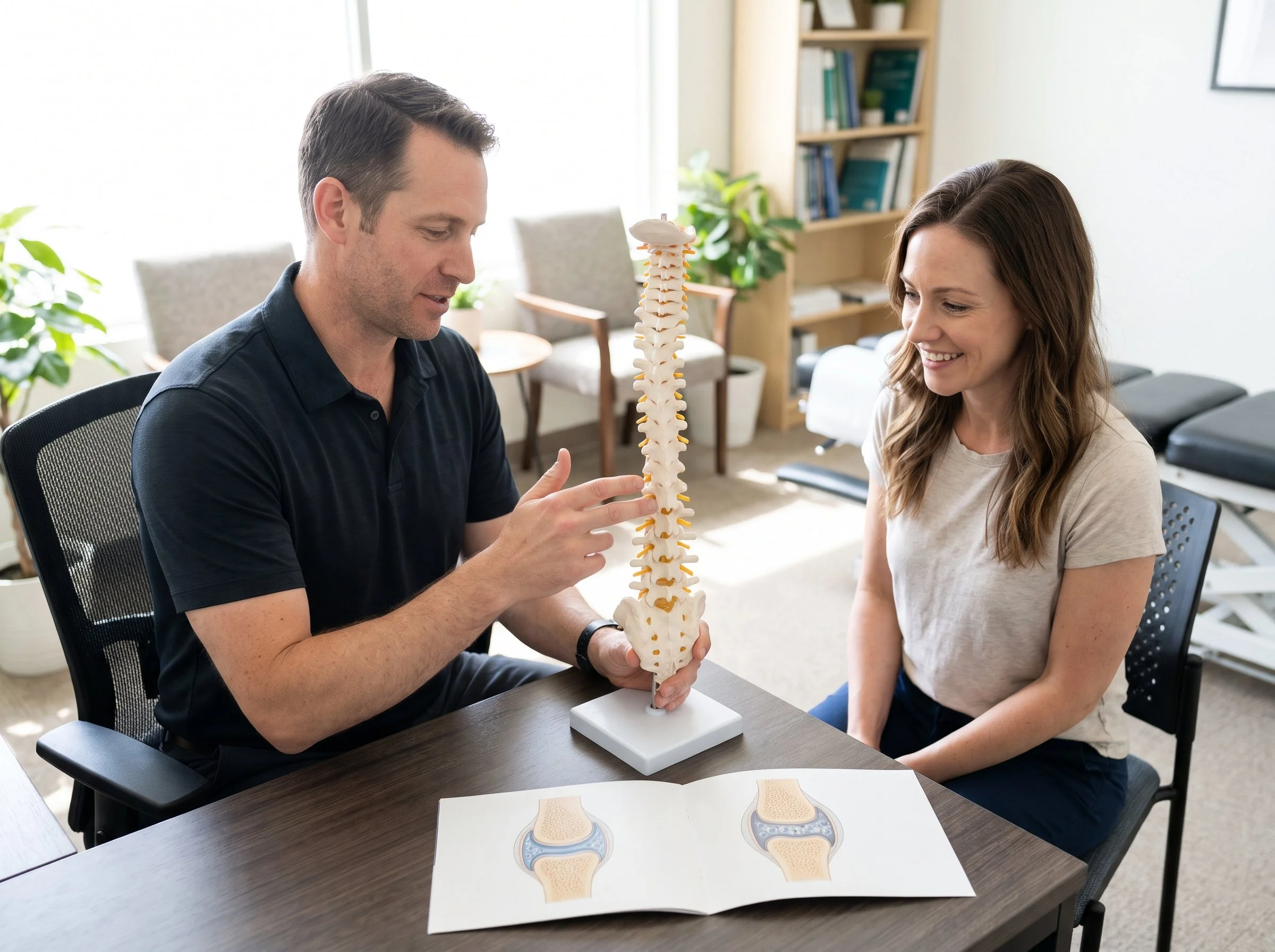
The popping sound some people hear during a chiropractic adjustment is one of the most common things patients ask about. It is not bones cracking, and nothing is being put back into place. This post explains where the sound comes from and whether it matters. For what happens at a first appointment, see What to Expect at Your First Visit.
Where the Sound Comes From
The joints of the spine and fingers sit inside a capsule filled with lubricating fluid.
When the joint surfaces are separated quickly, a gas-filled space forms in that fluid. In a 2015 study led by the University of Alberta, researchers filmed a finger joint being pulled inside an MRI scanner and saw this space appear at the moment of the sound.
For decades the sound was put down to a bubble collapsing. The MRI study pointed to the space forming instead.
After a joint cracks, it cannot crack again for about 20 minutes.
A useful comparison is pulling a suction cup off a window: the two surfaces resist, then separate suddenly with a pop.
Does the Pop Need to Happen?
No. A 2022 systematic review of studies on audible pops during spinal manipulation found no evidence that a pop was linked to better pain outcomes.
In one of the earlier studies, 71 people with low back pain all received the same manipulation. A pop was heard in 50 of them, and improvement in pain, disability and movement was the same whether or not it happened.
What this means: a quiet adjustment is not a failed one. Many hands-on techniques, such as mobilization and soft-tissue therapy, are not meant to produce a sound at all.
Is Cracking Your Knuckles Harmful?
A study of 215 people aged 50 to 89 found that habitual knuckle cracking was not linked to osteoarthritis of the hand, no matter how many years or how often people had done it.
That finding is about knuckles. There is much less research on habitually cracking your own neck or back. If you feel a constant need to do it, the stiffness behind that urge is worth having assessed.
What an Adjustment Is, and Is Not
An adjustment, also called spinal manipulation, is a quick, controlled movement applied to a joint.
It does not put a bone back in place.
Guidelines list manipulation as one option for back and neck pain, usually alongside exercise and advice.
Mild soreness or stiffness for a day or two afterward is common, and serious complications are rare.
You can always ask for care without manipulation.
When to Get a Joint Noise Checked
Joint noises without pain are usually nothing to worry about. Book an assessment if a clicking or grinding joint is also painful, swollen, locking or giving way, or if the noise started after an injury.
Seek urgent medical attention for neck pain that comes with a sudden severe headache, dizziness, double vision, trouble speaking or swallowing, or numbness or weakness in the face, arm or leg.
What to Expect
A history and examination before any treatment.
An explanation of the options, benefits and risks, and your consent before any adjustment.
Care that may include manipulation, mobilization, soft-tissue therapy, medical acupuncture and exercise, depending on your assessment and your preferences.
A reassessment after a short course of care.
Not everyone improves. If you are not improving at the reassessment, the plan is changed or you are referred on.
Book an Assessment in NW Calgary
Dr. Lau will assess you first and explain your options before any treatment. Dr. Michael Lau, Calgary Chiropractor, 3604 52 Ave NW #138, Calgary, AB T2L 1V9. Call (403) 282-4004 or book online. Related reading: What to Expect at Your First Visit and Chiropractor, Physiotherapist or Massage Therapist: Who Should You See?