
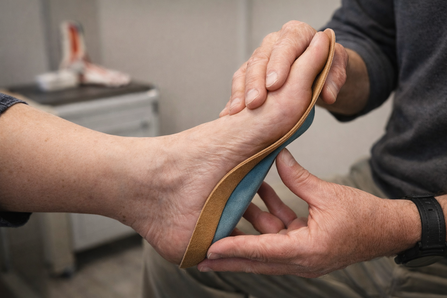
“Do I need custom orthotics, or will an insole from the pharmacy do?” It is one of the most common questions patients ask about their feet. The honest answer is that it depends on the problem and on your feet. Research gives some useful guidance.
What Is the Difference?
Store-bought (prefabricated) insoles are made in standard shapes and sizes. Custom orthotics are made from a scan or mould of your feet, to a prescription that follows an assessment. They can also be adjusted after they are made. Custom orthotics cost several times more. Some extended health plans cover part of the cost, usually with conditions, so check your own plan.
What the Research Says
Plantar heel pain (plantar fasciitis). Two 2018 systematic reviews in the British Journal of Sports Medicine looked at this. One, covering 19 trials and 1,660 people, found moderate-quality evidence that foot orthoses reduce pain more than sham devices at 7 to 12 weeks, though the effect was small. Its lead author reported that prefabricated orthoses did as well as custom ones. The other, covering 20 studies, found orthoses no better than sham devices or other conservative treatments. A 2023 clinical practice guideline advises that orthoses, prefabricated or custom, should not be used on their own for short-term relief but can be part of a combined plan.
Painful high arches. A Cochrane review rated the evidence for custom orthotics strongest here. In a trial of 154 people with painful high-arched feet, custom orthotics reduced pain more than sham devices at three months.
Arthritis-related foot pain. The same Cochrane review found some evidence for custom orthotics in rheumatoid arthritis and painful bunions, from fewer and smaller studies.
Kneecap (patellofemoral) pain. An international expert panel supports foot orthoses to help with pain. In a randomized trial, prefabricated orthoses gave more improvement than flat inserts at six weeks.
Across these reviews, there is no good evidence that custom orthotics work better than prefabricated ones for common problems such as heel pain. Where custom orthotics have their strongest support, in painful high-arched feet, they were tested against sham devices rather than store-bought insoles.
When a Store-Bought Insole Is a Reasonable First Step
Heel or arch pain that started in the last few months
Kneecap pain linked to running or stairs
Feet that fit comfortably in standard shoes and insoles
Choose one that feels comfortable straight away, has a firm contoured arch rather than soft foam alone, and fits your shoe once the factory liner is removed. Give it a few weeks alongside your exercises before judging it.
When Custom Orthotics Are Worth Considering
Painful high arches
A foot shape that standard insoles do not fit well, such as very flat feet, very high arches or noticeably different left and right feet
Arthritis-related foot pain or changes in foot shape, in coordination with your physician
A store-bought insole that was uncomfortable or did not help after several weeks
A need for specific adjustments, such as taking pressure off one spot or fitting work boots or skates
These are situations where a device shaped to your foot and adjusted for you has a practical advantage, even though research directly comparing the two types is limited.
Custom Orthotics Are Modular and Adjustable
A custom orthotic is not a single fixed shape. Think of it as a base with parts that can be added, removed or changed. That lets Dr. Lau adjust the device to bias how your foot and leg are loaded, and change it again if your needs change.
Wedges (posting) under the heel or forefoot tilt the foot slightly inward or outward to change how much it rolls.
Arch height and shell stiffness set how much support and how much give the device has.
Heel lifts raise the heel to alter the load on the calf and Achilles tendon.
Metatarsal pads shift pressure away from the ball of the foot.
Cut-outs and extra cushioning take pressure off a specific sore spot.
Top covers can be swapped to suit different shoes, sports or skin comfort.
Research supports the idea that these features change mechanics. In one review of studies in people without injury, wedged (posted) orthoses reduced how far the heel rolled inward by about two degrees, and moulded orthoses reduced impact loading. In a study of older adults with forefoot pain, metatarsal pads lowered pressure under the ball of the foot. These changes are small, and a change in mechanics does not always mean a change in pain, so Dr. Lau reviews how you respond and adjusts from there.
What Orthotics Will Not Do
Orthotics are one part of a plan that also includes footwear, strengthening and activity changes. The best evidence is for foot pain and some knee pain. For hip and back pain the evidence is limited. If you have diabetes, reduced feeling in your feet or a foot ulcer, your foot care should be coordinated with your physician or podiatrist.
How Dr. Lau Approaches It
Dr. Michael Lau, Calgary Chiropractor, starts with a biomechanical assessment and gait analysis and recommends custom orthotics only when they are likely to help. If a store-bought insole is a sensible first step for you, he will say so. For what the process involves, see the Custom Orthotics page. If you already have orthotics, see Getting Used to Custom Orthotics.
Book an Assessment in NW Calgary
Dr. Michael Lau, Calgary Chiropractor, 3604 52 Ave NW #138, Calgary, AB T2L 1V9. Call (403) 282-4004 or book online.
Sources
Koc TA, et al. Heel Pain – Plantar Fasciitis: Revision 2023. J Orthop Sports Phys Ther. 2023.
Collins N, et al. Foot orthoses and physiotherapy in the treatment of patellofemoral pain syndrome: randomised clinical trial. BMJ. 2008;337:a1735.